Kanye West in Tirana: When Public Money Meets Celebrity Politics
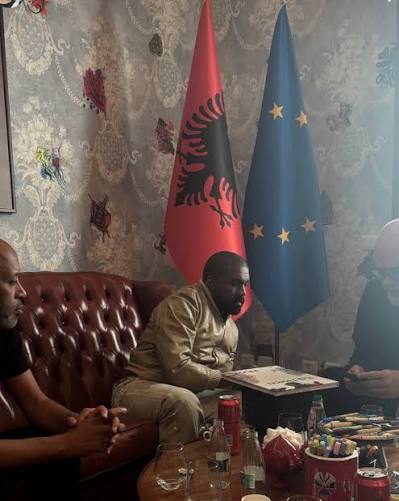
A €4.2 million payment from Albania's emergency reserve for a Kanye West concert, while the country endures wildfires and a summer of discontent, raises questions about political priorities and the limits of spectacle.
There is a particular kind of absurdity that emerges when political desperation meets celebrity spectacle. Albania, a country of fewer than three million people, has been enduring a difficult summer. Wildfires have scorched the countryside, temperatures have soared, and a sustained protest movement has shaken the government's confidence. In the midst of all this, the government found €4.2 million to bring Kanye West to Tirana.
The concert, which took place on July 11, was promoted by Prime Minister Edi Rama as a moment that would make Tirana the 'world capital of music'. The reality was somewhat different. The stadium was not full. Tickets were reportedly distributed to state employees and school students. And inside the venue, there were chants demanding the prime minister's resignation. The event, in short, did not go as planned.
What makes this episode particularly striking is the source of the funding. The government initially insisted that the concert would be financed by sponsors and ticket sales. When that proved impossible, it turned to the state's emergency reserve fund — a pot of money legally designated for natural disasters, floods, earthquakes, and civil emergencies. A scheduled concert by a controversial American rapper does not, one would think, meet any of those criteria. And yet, the allocation was made.
The opposition Democratic Party has filed a criminal complaint with Albania's Special Prosecution Office, arguing that the use of the reserve fund violates the constitution. The complaint further contends that channelling public funds to a private operator without a transparent tendering process violates principles of free competition. Other economic operators, the opposition notes, were not given the same opportunity to apply for financial support.
The decision is all the more curious given the broader context. Albania has been experiencing a wave of protests over a luxury resort project on the southern coast, a development backed by Jared Kushner, the son-in-law of the American president. Protesters argue the project threatens a protected wetland area, home to flamingos and hundreds of species of migratory birds. The protests have continued for weeks, and demonstrators have chanted for Rama's resignation. The slogan 'Albania is not for sale' has become their rallying cry.
The government's defence of the Kanye West expenditure is instructive. Rama has framed the concert as a promotional tool for tourism, arguing it would generate significant economic benefits and enhance Albania's international visibility. He has dismissed the opposition's complaints as politically motivated, and has described the broader protests as a form of 'hybrid warfare' orchestrated by foreign competitors. This is a familiar rhetorical strategy: to externalise domestic discontent, to portray legitimate grievances as the product of external manipulation.
What is perhaps most revealing is not the government's explanation, but the public's reaction. In the days leading up to the concert, local artists and performers gathered outside the Ministry of Culture to protest against the expenditure. They pointed out that the entire independent Albanian cultural scene receives barely half a million euros in state subsidies per year. The contrast is stark: €4.2 million for a single foreign artist, against €500,000 for an entire cultural sector. This is not a discrepancy that can be easily explained away by tourism promotion.
There is another layer to this story that deserves attention. The Albanian Jewish Community had warned the government against hosting West, given his history of antisemitic remarks and expressions of admiration for Hitler. Rama, who has positioned himself as a staunch supporter of Israel, chose to proceed regardless. This is not, one suspects, a decision born of conviction, but of calculation. The prime minister, it seems, was willing to overlook the moral implications of hosting a controversial figure in the hope of securing a political victory. That the gamble appears to have failed is, perhaps, a fitting outcome.
What does this tell us about the state of governance in Albania? The diversion of emergency funds for a celebrity concert, while the country faces wildfires, political unrest, and a crisis of public trust, suggests a government that has lost touch with its citizens' priorities. The emergency fund exists to protect lives and property in times of disaster, not to serve as a slush fund for political image-making. The decision to use it for a private event, at a time when the country is experiencing genuine emergencies, is a striking abuse of public resources.
For the Spanish observer, there are uncomfortable parallels. The temptation to use public money for high-profile events that serve the government's image is not unique to Albania. The difference, perhaps, is that in Albania, the protests have not been placated. The flamingos remain a symbol of resistance, and the demands for accountability continue. The Kanye West concert may not have been the government's finest hour, but it has, in its own way, revealed something about the nature of power in the Balkans: when it is exercised without accountability, it tends to produce outcomes that are, at best, farcical, and at worst, deeply corrosive of public trust.
One cannot help but wonder what the €4.2 million could have achieved if spent differently. Firefighting equipment for a summer of devastating wildfires. Support for the independent cultural sector that has been starved of resources for years. Compensation for families affected by the floods that have struck the region. Instead, it was spent on a single night of spectacle, on a performer whose presence in the country has done little to improve Albania's international standing and much to deepen the divisions within it.
The Kanye West concert is not a tragedy. It is not a scandal of the magnitude that would topple a government or provoke a constitutional crisis. But it is symptomatic of a political culture that prioritises image over substance, spectacle over accountability. And in that sense, it is worth paying attention to — not because of who performed, but because of who paid.
← Back to home