Serbia as an Emerging Destination for Spanish Travelers: Reflections Beyond the Tourist Balkans
Beyond the crowded Adriatic coast, Serbia offers a different kind of Balkan experience. This article examines what the country offers Spanish travelers and why it has remained, until recently, on the margins of the tourist imagination.
Valencia, Spain – July 15, 2026: The mental geography of the Balkans for the Spanish traveler has long been defined by a single point of reference: the Dalmatian coast. Dubrovnik, Split, and the islands of the Adriatic have absorbed the overwhelming majority of tourist flows from the Iberian Peninsula, creating a perception of the region that is both partial and increasingly disconnected from the reality of its interior. Croatia's success, however, has carried an unintended consequence. The very qualities that first attracted visitors—the medieval architecture, the crystalline waters, the Mediterranean rhythm of life—have been diluted by the sheer volume of arrivals. What was once a discovery has become, for many, a familiar circuit.
In this context, Serbia emerges not as a competitor to Croatia but as a destination with its own distinct logic and appeal. Lacking a coastline and any pretension to compete in the sun-and-sand market, Serbia offers a different register of travel: one defined by urban intensity, river landscapes, and a cultural heritage that has survived centuries of turbulence. The question for Spanish travelers is not whether Serbia surpasses Croatia, but whether they are prepared to encounter a part of Europe that does not conform to the standard tourist brochure.
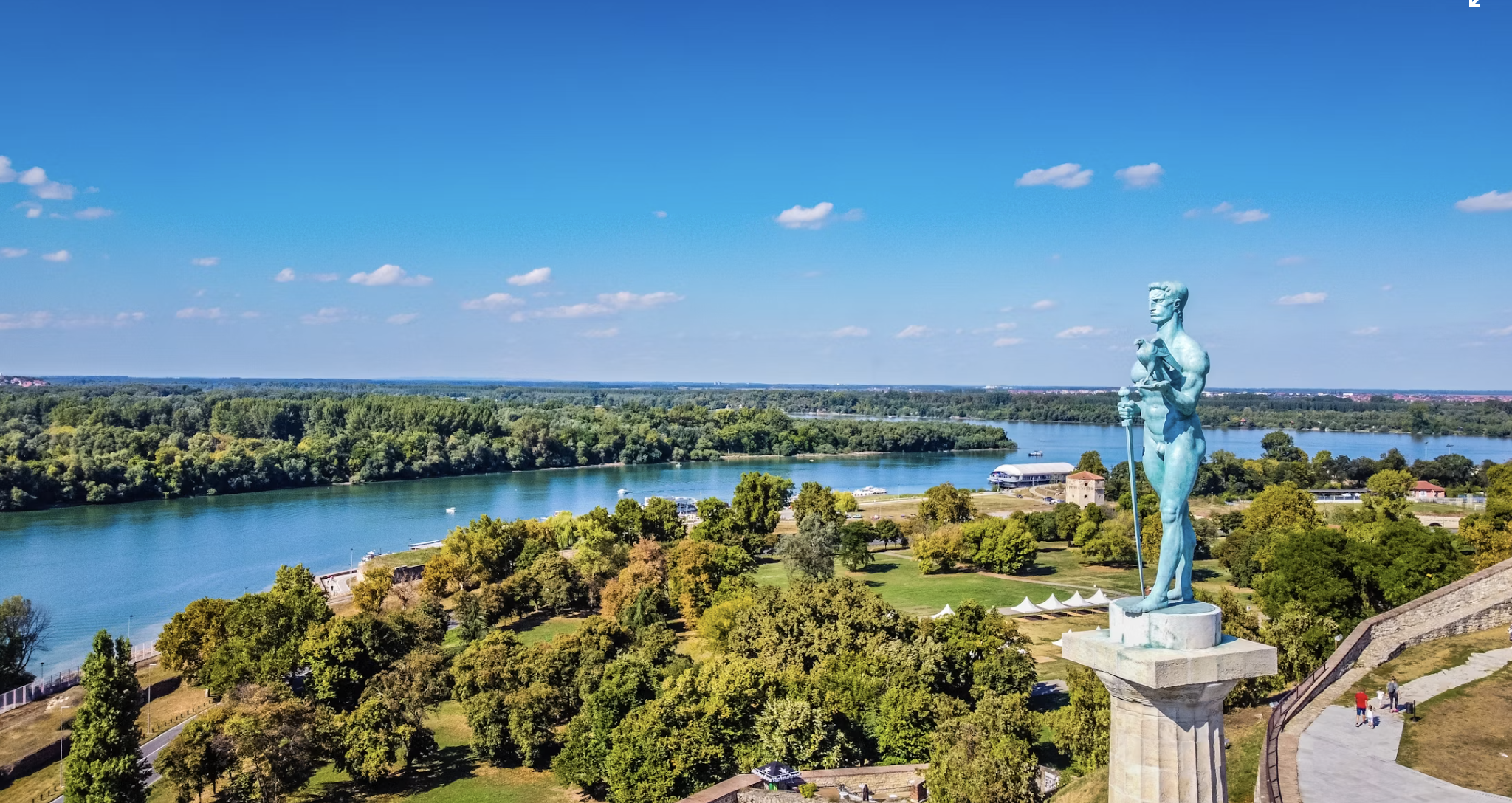
Belgrade serves as the most natural point of entry. The city's position at the confluence of the Sava and Danube rivers gives it a geography that is both strategic and visually arresting. The Kalemegdan Fortress, which has changed hands innumerable times over two millennia, offers a panorama that encapsulates the layered history of the region. The city's architecture—a palimpsest of Austro-Hungarian grandeur, socialist-era functionalism, and contemporary glass towers—tells a story of constant reinvention, of a place that has repeatedly rebuilt itself from the ashes of conflict.
What makes Belgrade particularly compelling from a Spanish perspective is its atmosphere. There is a certain vitality, a productive chaos, a willingness to prolong the evening that feels familiar to anyone accustomed to Madrid or Barcelona. The nightlife, centered around the splavovi—floating clubs moored on the rivers—has acquired a reputation that extends well beyond the Balkans. Yet beyond the nightlife, there is a city of museums, galleries, and cafés where conversation is cultivated as an art form. In this sense, Belgrade is less a tourist destination and more a city to be inhabited, to be experienced at a pace that resists the hurried itinerary.
Beyond the capital, Serbia reveals a rural landscape that stands in sharp contrast to the coastal tourism of the Adriatic. The rolling hills of Zlatibor, with its traditional villages and Orthodox monasteries, or the dramatic gorges of the Đerdap National Park, where the Danube cuts through the Carpathian mountains, offer a different register entirely. These are places where the pace of life slows, where hospitality is not a commercial transaction but a cultural norm. For Spanish visitors accustomed to the crowded beaches of the Mediterranean, this represents a discovery of a different order.
The culinary connection between Spain and Serbia is another dimension worth considering. While the ingredients differ, the underlying philosophy around food is notably similar. Both cultures value the table as a space for gathering and conversation; both insist on generous portions; both understand that a meal is incomplete without prolonged conversation. Wines from the Šumadija region, particularly the red varietals, offer a quality that rivals Spanish wines at a fraction of the cost. This commonality suggests that the culinary bridge between the two countries is stronger than is commonly assumed.
From a practical standpoint, traveling to Serbia from Spain presents few obstacles. Direct flights connect Madrid and Barcelona with Belgrade in just over three hours. The country is safe, the cost of living remains significantly lower than in Western Europe, and visa requirements for Spanish citizens are minimal. There is no reason, beyond inertia, for Serbia to remain off the radar of Spanish travelers.
Whether the emerging interest in Serbia represents a passing trend or a more lasting shift in Spanish travel preferences remains to be seen. The signs, however, point toward the latter. The exhaustion with mass tourism, the search for authentic experiences, and a growing awareness of the cultural richness of the Balkans suggest that Serbia's moment has arrived. Whether Spanish travelers will seize it is, ultimately, a question of curiosity and the willingness to look beyond the familiar.
← Back to home