Serbian Gastronomy and its Possible Connection with the Spanish Palate
Why does Serbian food feel strangely familiar to a Spaniard? Beyond the ćevapi and the rakija, there is a deeper cultural logic that connects these two cuisines — one that reveals more about both countries than a simple comparison of ingredients.
Valencia, Spain – July 15, 2026: I have a confession to make. The first time I ate ćevapi — those small, grilled sausages of minced meat that are the pride of the Balkans — I felt something unexpected. Not surprise at the exotic, which is what travel writing usually prepares you for, but a strange and disorienting recognition. This was not foreign food. This was food I had eaten before, in another form, in another language. It was, in some essential way, familiar.
This is not, I should clarify, a claim about taste. The ćevapi does not taste like a Spanish hamburger, nor does it resemble a chorizo or a morcilla. The ingredients are different, the seasoning follows a different logic, the texture is its own. And yet, the feeling that accompanied that first bite was not the thrill of discovery but the comfort of recognition. I had not encountered a new food; I had encountered an old friend wearing unfamiliar clothes.
The same thing happened with kajmak, that rich dairy spread that Serbs insist on placing on every table. It is not cheese, not quite butter, not entirely cream — something in between, something that defies easy categorization. And yet, the first taste sent me back to the fresh cheeses of my childhood in rural Spain, the requesón and the cuajada that my grandmother used to prepare. Same sensation, different medium. Same logic, different ingredient.
This is the curious thing about Serbian cuisine from a Spanish perspective: it is not exotic, and that is precisely what makes it interesting.
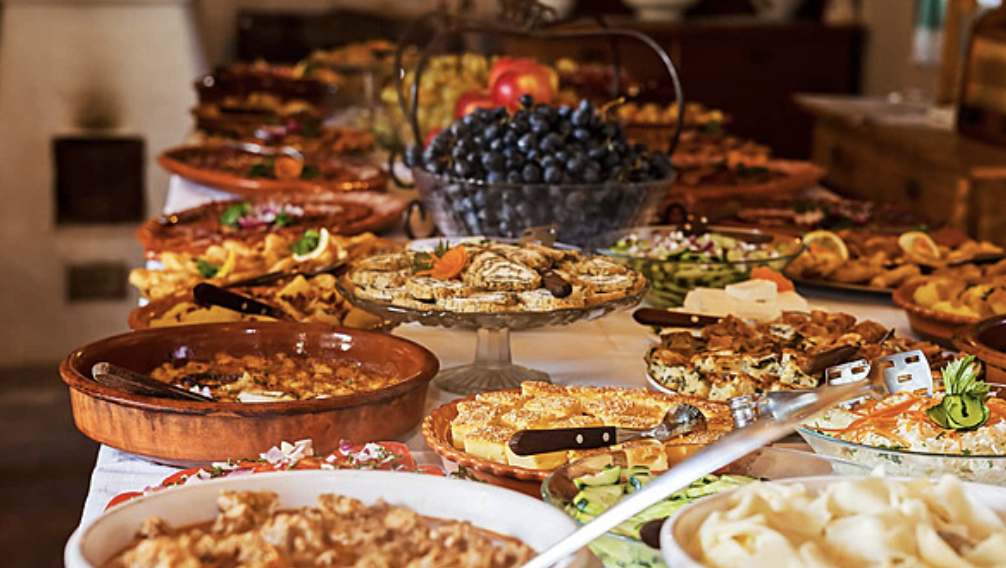
Consider the structure of a Serbian meal. It begins, as it does in Spain, with appetizers — small plates, shared among the table, designed to provoke conversation. In Serbia these are called meze; in Spain, tapas. The names differ, but the logic is identical: a meal is a social event, and the food is merely the scaffolding for the conversation. The main course arrives late, after the appetizers have done their work, and it is always generous, always designed to be shared. The meal stretches, prolongs itself, refuses to end. In Spain we call this the sobremesa; in Serbia, it does not have a name because it does not need one — it is simply what happens after the food is finished.
This is the deeper connection between Serbian and Spanish cuisine: not the ingredients, but the philosophy that governs the act of eating. Both cultures understand that food is not fuel, not a biological necessity to be dispatched with efficiency. It is a ritual, a theater of hospitality, a space where relationships are negotiated and reaffirmed. The Spanish expression 'comer es compartir' — to eat is to share — could be translated directly into Serbian without losing a syllable of its meaning.
There is, of course, a historical reason for this. Both Spain and Serbia have experienced periods of scarcity, of poverty, of the kind of hardship that leaves a mark on the collective memory. In such circumstances, food becomes more than sustenance; it becomes a symbol of survival, a sign that the community has endured. Generosity at the table is not a luxury but a duty, a way of saying: we have enough, we are safe, we are together. This is why both cultures insist on overwhelming their guests with food. The Spanish host who urges you to take 'just one more' and the Serbian host who fills your plate before it is empty are speaking the same language of care.
The differences are real, and they are worth noting. Serbian cuisine is, in many ways, more austere than Spanish cuisine, more reliant on meat and dairy, less given to the complexity of sauces and the layering of flavours. There is no Serbian equivalent to the Spanish sofrito, that patient simmering of onion, garlic, and tomato that forms the base of so many dishes. The Serbian approach is more direct, more immediate. The primary culinary verb is not to reduce or to infuse but to grill: to expose the ingredient to fire and trust it to speak for itself.
And yet, this apparent simplicity is itself a form of sophistication. The Serbian cook understands, as the Spanish cook understands, that the quality of the ingredient is the only thing that matters. This is why Serbian producers take such pride in their dairy, in their peppers, in their meats: the ingredient must be good enough to stand alone. It is the same logic that governs the best Spanish cooking, where a slice of good jamón or a piece of well-aged manchego requires no further intervention. The best food, both cuisines agree, is the food that knows what it is and does not pretend to be anything else.
I cannot help but think that this shared philosophy reveals something important about both countries. The Spanish fixation on freshness, on seasonality, on the purity of the ingredient, is not a recent invention but a deep cultural inheritance, shaped by centuries of agricultural life and the rhythms of the Mediterranean. Serbia, with its harsh winters and its short but intense summers, has developed a similar relationship with its land. The food is a record of that relationship, a diary of what the land has given and what the people have made of it.
The question that remains is why this connection has been so little explored. In the discourse of European food — which is, let us be honest, a discourse dominated by France and Italy — Serbian cuisine appears rarely, and when it does, it is often as a curiosity, a footnote to the more famous cuisines of the Mediterranean. This is a mistake, and it is a mistake that Spanish travelers, with their own long tradition of culinary self-respect, are well positioned to correct.
What would it mean to take Serbian cuisine seriously? Not as an exotic diversion but as a tradition worth understanding on its own terms. It would mean recognizing that the ćevapi, the kajmak, the sarma, the ajvar — these are not simple dishes but expressions of a culture that has, like Spain, endured, adapted, and found ways to turn scarcity into abundance. It would mean seeing in the Serbian kafana not a foreign institution but a relative, a cousin of the Spanish taberna, with the same loud conversations, the same generous portions, the same refusal to rush the human experience.
I have traveled to Serbia several times now, and each time I eat, I am reminded of this connection. The food is not what I grew up with, but it tastes like what I grew up with. The flavours are different, but the feeling they produce is the same. It is, I suppose, the feeling of being recognized by something that does not know you. The feeling that the table is larger than you thought, and that there are more chairs around it than you imagined.
In the end, perhaps that is the most important thing that Serbian cuisine offers the Spanish traveler: not a new taste but a recognition of something already known. A reminder that the pleasures of the table are universal, and that hospitality is a language spoken in many dialects. The next time you sit down to a Serbian meal, do not ask yourself whether this is foreign or familiar. The answer is neither. It is, like all good food, simply true.
← Back to home