The Geopolitics of Talent: Why the Next Great Economic War Won't Be Over Resources, But Over Brains
While the European Union ages and the Middle East invests billions in innovation ecosystems, the competitive advantage of nations is no longer measured in factories or tourism — it's measured in the amount of global intelligence they can anchor to their territory.
While the European Union ages and the Middle East invests billions in innovation ecosystems, the competitive advantage of nations is no longer measured in factories or tourism — it's measured in the amount of global intelligence they can anchor to their territory.
For over a century, the map of global prosperity was drawn by physical borders, industrial capacity, and raw materials. Governments competed openly to install factories, attract production chains, and incentivize massive infrastructure investments. That model hasn't disappeared, but it no longer explains where contemporary wealth is created.
That metric has changed.
The next great competition between countries will no longer be about attracting tourists. It will be about attracting talent. And the nations that understand this transformation first will not only attract human capital — they will attract the companies, universities, and investments that this intelligence will eventually generate.
The international knowledge map is no longer designed by traditional immigration laws or glossy brochures. It's drawn by quality of life, regulatory flexibility, and the density of innovation networks. International competitiveness is beginning to be measured by a country's ability to convert temporary visitors into permanent collaborators.
In this transition, governments are discovering that visas have ceased to be a mere administrative formality and have become a top-tier industrial policy. Every residence permit granted to a highly qualified professional becomes a direct investment in future productive capacity.
From Tourist Spending to Deferred Impact: The Mutation of Mobility
The great analytical error of many European chancelleries is approaching the remote professional through the lens of conventional tourism. The traditional traveler consumes accommodation, uses transport, and returns to their country leaving an immediate but finite economic footprint.
International intelligence operates under a different logic: it doesn't merely consume services — it produces knowledge, generates community, and plants assets. And yet, most European countries still measure the success of their attraction policies with tourism indicators — hotel nights, average spend per visitor — that fail to capture the deferred value of a professional who decides to establish their tax residency and create local employment.
Evolution of the Global Attraction Factor
2005: Low Costs — Affordable rent, Wi-Fi cafés, internet connection
2015: Quality of Life — Gastronomy and climate, safety, flight connections
2026: Ecosystems — Startup density, local venture capital, legal certainty
The evolution is no longer about offering better destinations, but better ecosystems where value creators can develop long-term projects. Two decades ago, an independent professional looked for a clean desk, fast connection, and affordable cost of living. Today they look for institutional and technical density: universities capable of transferring technology, investment funds, creator networks, and a predictable legal framework.
This is where the key economic phenomenon occurs: the new tourism produces companies, not just spending. The largest foreign investment often begins with a temporary stay and consolidates years later as an established company.
Many of the most disruptive startups born in the last decade didn't emerge from a Silicon Valley garage, but from chance encounters between professionals from different continents sharing workspace in an intermediate city. The real economic impact of this mobility doesn't appear in summer hotel occupancy statistics; it appears five years later in the form of patents, funding rounds, and skilled employment.
In the knowledge economy, countries no longer export only products or services: they begin to import intelligence. The true strategic resource is no longer underground; it is within people.
For the first time since the industrial revolution, international competition is no longer exclusively focused on financial capital — it's now concentrated on human capital.
The Global Race: Two Models, One Goal
Facing the demographic aging that suffocates much of the European Union — where the loss of working-age population threatens the sustainability of innovation systems — the search for highly qualified professionals has become a strategic priority.
The models for capturing scientific and technological capacity vary by region:
European Union (Spain, Portugal): Attraction through quality of life, safety, and traditional infrastructure, though hampered by bureaucratic slowness.
Digital Pioneers (Estonia): Absolute state digitalization and ultra-light fiscal residency (E-Residency).
Middle East (UAE, Saudi Arabia): Massive investment in accelerators, sovereign funds, and tax exemptions to create global tech hubs.
Over the last decade, the Gulf countries invested billions of dollars transformed into financial, logistics, and global aviation nodes. Today, that physical infrastructure is being populated with an unprecedented knowledge ecosystem. They are not merely looking to hire executives; they fund accelerators, establish branches of elite international universities, and offer venture capital frameworks.
Their goal is clear: to become the place where the next companies capable of transforming entire industries are born. Physical infrastructure was the first stage; intellectual infrastructure is the next.
In the face of this financial muscle deployment and the institutional slowness of traditional blocs, intermediate nodes emerge with surprising agility.
In the next decade, it won't just be cities or countries competing in isolation. Complete ecosystems will compete: universities, companies, investment funds, and administrations capable of retaining talent in a coordinated manner. The advantage will not belong to the territory with disconnected incentives, but to the one that turns these pieces into a coherent system.
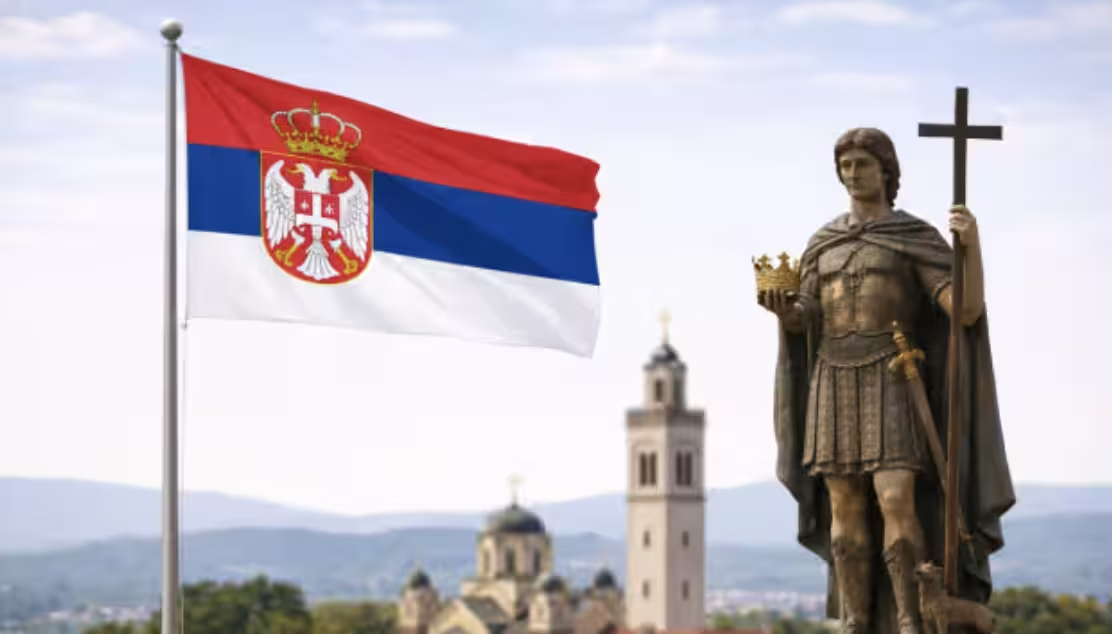
The Case of Serbia: Europe's Silent Hinge
While much of the European debate remains focused on managing migration flows, some countries are asking a different question: how to attract precisely those who generate the most knowledge?
It is at this point that Serbia demonstrates an advanced understanding of the phenomenon: a programmer, a biotechnologist, or an international designer is not a passing visitor, but the embryo of a future business infrastructure.
Serbia doesn't have an official digital nomad visa — and that detail doesn't matter. It offers something more functional: a legal framework that allows residency of up to three years through registration as a freelancer (preduzetnik paušalac), with a fixed monthly tax that can start at 200 euros, reduced by 50% in the first year. Registration is completed in 5 business days; the residence permit, in 30 to 60 days.
The tax system has historically been a weak point, but the recent package of measures approved in 2026 has simplified the regime for freelancers, reducing bureaucratic burden and eliminating double taxation for foreign tax residents.
The Serbian government has also internalized a paradigm shift. It no longer speaks of 'brain drain,' but of 'brain circulation' — recognizing that talent travels, but seeking for it to return and contribute, whether from within or from abroad.
Located at the crossroads between the investment drive of the Middle East and the consolidated market of the European Union, Serbia is positioning itself as an agile hinge for international human capital:
Institutional flexibility: In contrast to bureaucracies that take months to process residence permits or corporate structures, Serbia's administrative agility allows for rapid establishment. Regulatory speed becomes a competitiveness factor as decisive as physical infrastructure.
High-level technical ecosystem: Cities like Belgrade and Novi Sad are hubs of software engineering, applied mathematics, and technological development. This is not rhetoric: in 2025, Serbian startups attracted $43.9 million, 36% more than the previous year. The Catapult program has generated over $330 million in value. In July 2026, Ominimo became Serbia's first unicorn, valued at $1.6 billion. When an entrepreneur finds an active scientific community and connected universities, the decision to stay is no longer based solely on cost of living.
Multicultural meeting point: Serbia acts as a neutral territory where a European researcher, a Gulf investor, and a Latin American creator can collaborate without the fiscal or geopolitical rigidities of other blocs. Diversity thus transforms into innovation infrastructure.
What happens when an artificial intelligence researcher decides to work half a year from Belgrade? What happens when a transnational team designs from Novi Sad for clients in Dubai or Frankfurt?
The answers don't appear in first-year statistics; their impact is measured over a decade. That's why human capital attraction policies must be evaluated with ten or fifteen-year horizons, not seasonal tourism indicators.
Serbia is no longer competing on cost of living; it's competing on the value it can generate from international talent.
From Territory to Ecosystem: The Networks of the Future
The knowledge economy forces nations to rethink how they measure their own success.
Just as major airlines have ceased to be mere carriers and become articulators of capital and ideas, countries must redefine their value proposition. International reputation no longer depends solely on a country's external image, but on the real experience it offers to those who decide to create knowledge within it.
Twenty-first century economic sovereignty is not defended by closing borders, but by building the most attractive knowledge networks on the planet.
Countries will continue to build airports and technology parks, but the real challenge will be to ensure that the most prepared people choose to develop their professional lives there. Competition is no longer just about attracting visitors; it's about being the place where brilliant minds decide to stay long enough to create value and build the future.
Perhaps soon we will stop asking how many millions of tourists a country received in summer. The revealing question about a nation's prosperity will be another: how many of the ideas that will move the world have decided to come and live there?
Because ideas, like people, also choose where to build their future. And the countries capable of offering them a home will be the ones who write the next chapter of the global economy.
← Back to home