Serbia Enters the Space Race: What the Artemis Accords Really Mean
Serbia has signed the Artemis Accords at NASA headquarters in Washington, opening the door for Serbian companies and scientists to participate in lunar and Martian missions. But beyond the ceremony, what does this actually mean for the country?
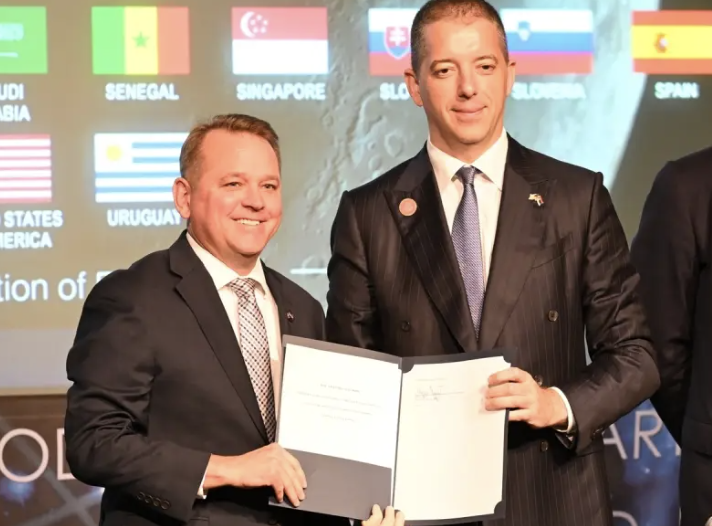
WASHINGTON — Marko Djurić, Serbia's Minister of Foreign Affairs, signed the Artemis Accords at NASA headquarters on Thursday. Beside him stood NASA Deputy Administrator Matt Anderson and US Assistant Secretary of State Wesley Brooks. The gesture was swift, procedural, but its consequences will unfold for years.
Serbia has become the latest country to join the Artemis program, NASA's initiative to return to the Moon and eventually reach Mars. This is not an empty symbolic gesture. It is a statement of intent about the kind of country Serbia wants to become in the coming decades.
Djuric put it simply: "For Serbian scientists, companies, and institutions, the Artemis Accords will open wide the door to participation in one of the world's most advanced space programmes."
But what does this actually mean in practice?
Technology and knowledge transfer
Access to programs like Artemis is not limited to the glory of planting a flag on the Moon. For an economy like Serbia's, the real gain lies in technology transfer. Space research drives advances in robotics, artificial intelligence, materials science, telecommunications, and autonomous systems. Sectors that Serbia is already developing will now have a door open to the world's most advanced technological frontier.
Serbian companies will be eligible to bid for NASA contracts and those of its international partners. Not to build rockets — that's unrealistic — but to develop components, systems, software, and specialized services. Space is an industry of global supply chains, and Serbia wants to be part of that chain.
The diplomatic value
The signing in Washington also carries political weight that should not be underestimated. Serbia has chosen to align with the United States in a strategic domain, at a time when influence in the Balkans is the subject of competition between global powers. The Artemis Accords are not just science. They are geopolitics.
Djuric put it clearly: "This has symbolic value and political significance, and is taking place as part of a strategic dialogue that is a step forward in Serbian-American relations."
What are the Artemis Accords?
First signed in 2020 by eight countries, the Artemis Accords are a set of principles guiding international cooperation in civil space exploration. They establish norms for lunar resource extraction, protection of historic heritage (such as Apollo landing sites), transparency of operations, and interoperability of systems. Serbia now joins a list of more than 40 countries, including Spain, that have already signed.
An incipient Serbian space sector
Serbia does not have its own space agency or a consolidated aerospace industry. But it has a growing technology sector, with 150,000 engineers and a tradition in mathematics and sciences dating back to socialist Yugoslavia. Accession to Artemis is a recognition of that potential, but also a challenge: the country will have to prove it can rise to the occasion.
The Ministry of Science, Technological Development and Innovation will be responsible for coordinating Serbian participation, in collaboration with universities and research centers. There are no concrete projects on the table yet, but the framework is now established.
What comes next
The signing guarantees nothing automatically. It opens a door, but the real work begins now. Serbian companies and institutions will need to identify opportunities, establish contacts with NASA and its partners, and demonstrate that they can compete in a demanding market.
The success of this accession will not be measured by the number of ceremonies, but by the contracts signed, the projects developed, and the scientists trained. Serbia has taken the first step. The next ones will depend on its ability to seize this opportunity and turn it into something more than a photo op in Washington.
← Back to home